

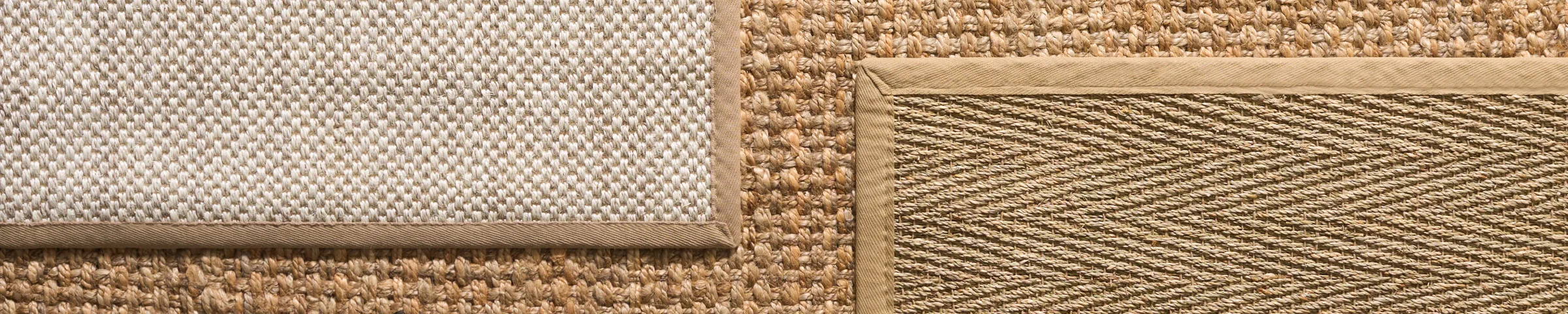
In order to find the right area rug and then properly arrange it to perfectly accentuate your décor, you'll need to consider more than just style, color, and material – size and shape matter, too.
When it comes to choosing the right rug size it can be overwhelming, given that rugs are notoriously expensive, which can be intimidating for a lot of people to invest in. Also, a wrong size or cheaper-looking rug can make the space look chopped up or look out of the proposition.
An optimal-sized rug in a shape that best suits a particular living space will help invigorate the entire aspect of a room while also displaying the finest qualities of the rug itself.
Here are some helpful tips on how to arrange a new area rug.
Know The Rules, Then Bend At Will!
In general, the rule of thumb is to allow approximately 18 inches of exposed floor space around the perimeter of an area rug.
However, the room's overall size and location should also be considered.
- The 18″ rule works well in rooms that are enclosed and separate from surrounding areas, while the look of smaller rooms may benefit from having less exposed floor space.
- Keep in mind that an undersized rug can make a room look small and make the other furnishings around it look uncoordinated. When it comes to area rugs, bigger can indeed be better.
- Before buying a rug, map out your room to scale and consider doorways, furniture size, and exposure to the sun, among other things. Pay attention to the details of your space and how everything will gel.
- Oftentimes, the style or color of the rugs also impacts how small or large it makes your space appear. So whether you are choosing shag rugs or brown rugs or any other, it depends upon its visual effect on the interior. For example, light colors make the space larger, whereas dark colors add drama and compactness.
Here's how you can measure the size of your rug:
The overall area of the rug is a product of its length and width, which you can measure in square feet.
To calculate the area of the rug, you need to use measuring tape to measure the length and width of your rug and then multiply both numbers to get the area.
E.g. If your rug's length is 5 ft and height is 3 ft, then the area of the rug will be 15 square feet.
While considering the area rug size, here are a few things to remember:
- Even if you are going for the largest area rug size, make sure the rug should be a few feet smaller than the room.
- Make sure that the rug is large enough to accommodate the furniture in your house.
- When choosing a rug for your living room, make sure it is large enough to accommodate your couch.
- When choosing a rug for your dining room, make sure it can fit all your chairs and dining tables even when the chairs are pushed out from the table.
- When choosing a rug for your bedroom, it should be large enough to accommodate your bed.
- When choosing an area rug for high-traffic areas, pick low-pile rugs for high-traffic areas as they can hide footprints and tracks.
- Choose rugs with heavy design work and detailed patterns for high-traffic areas to hide stains.
How To Choose the Right Area Rug Depending On Each Room?
Follow these simple steps when your rug arrives to ensure that it looks and feels best in your room decor.
Choosing Area Rug For Living Room
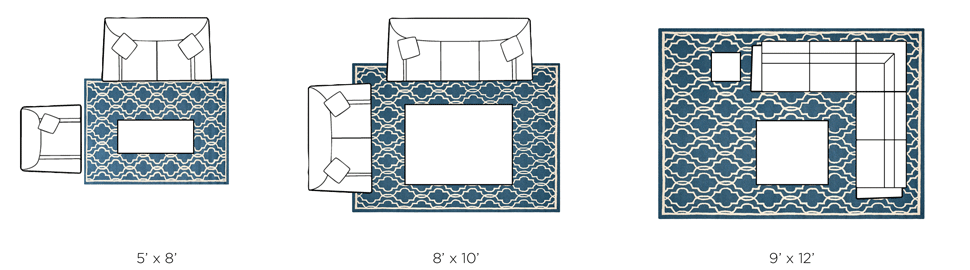
The dimensions of a living room will dictate the ideal size and shape of the rug for the space.
Here are some helpful tips that take into account the layout of the furniture using rectangular rugs.
For more examples, click here to view area rugs arranged in Safavieh Dream Living Rooms.
- 5′ x 8′ – All legs off, furniture surrounding edges of the rug – When opting for a smaller rug, keeping all legs of the furniture off and positioned around the edges of the rug is a smart choice. This is a particularly effective decorating strategy if your rug has bold, flamboyant patterns and coloring that you'd like to fill the room.
- 8'x10′ – Front legs on the outer edges of the rug – The most popular layout for living room furnishings. This arrangement will help to connect the furniture and harmonize room décor while also lending a wonderful sense of proportion to the entire space.
- 9'x12′ – All legs on the rug – For a much more "pulled-together" look, put all of the legs of the couches and sofas on the surface of a 9'x12′ area rug. This arrangement will tend to define and establish the aspect of a room provided that it is able to accommodate a larger rug.
Here are some tips to consider:
- Before you jump into buying, make sure you measure the living area and get the closest size to pick a suitable rug.
- If you are looking for a budget-friendly room and have a small room, consider looking for a smaller rug that can float in front of your furniture, especially if you are keeping a sofa or fortunes backed up against the wall.
- For furniture that is floating or a room in a bigger size, larger sizes of rugs can help make the space look smaller.
- To create a rustic and country-living style in your living room, you can add our Farmhouse rugs made of simple jute or woven rug, making your space more welcoming and relaxed.
- Avoid buying too large or too small sizes in rugs as it may make your living area look totally out of proportion and chopped up
- If you are not sure which type of rug to choose, simply go with contemporary rugs as they work well with modern, traditional and minimalist living rooms. It adds color and texture to your living room.
Choosing Area Rug For Dining Room
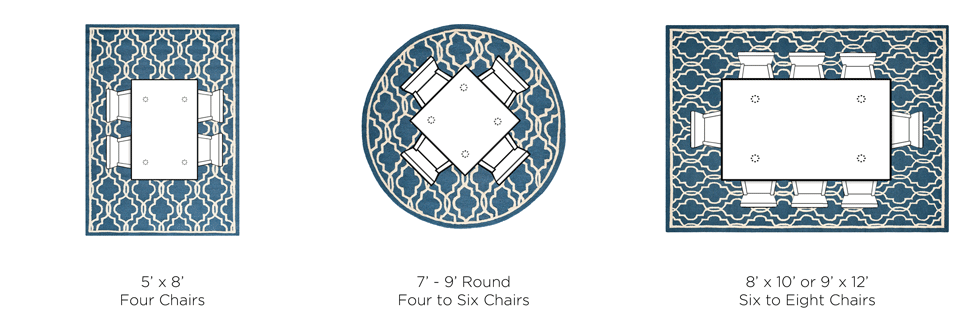
When choosing a rug for the dining room, be sure that it is big enough to allow all four legs of the chairs to sit comfortably on the rug, even when the chairs are pulled away from the table.
A loose rule of thumb to follow is that your rug should be extended at least 24 inches around the table.
- 5'x 8′ – Use a 5'x 8′ rectangular rug in smaller dining areas. The table and all four chair legs are on the rug.
- 8'x 10′ or 9′ x 12′ – These rugs will generally accommodate 6 – 8 chairs. Aim to leave approximately 18 inches between the rug’s edge and the walls, adjusting for room size.
- 7′ – 9′ Round – A round rug works nicely with a square table and 4 – 6 chairs around it. You can also use a rectangle-shaped rug under a square table.
Here are some of the tips to consider:
- Rugs are not meant to have wall-to-wall. Ensure you leave some space between the rug and the wall so there is a breathing room in order not to feel too tight.
- Also, not all dining rooms need to have a rug. However, make sure if you buy one it should offer plenty of room where you can put the chairs in and out.
- Another recommendation you can consider for the dining room is flatweave rugs, which allow for hassle-free moving and cleaning.
- Dark color rugs such as brown rugs or farmhouse rugs are often ideal for the dining room.
- You can pick options like tufted or low pile rugs, but avoid investing in thick piles and shapes that make them harder to clean.
Choosing Area Rug For Bedroom
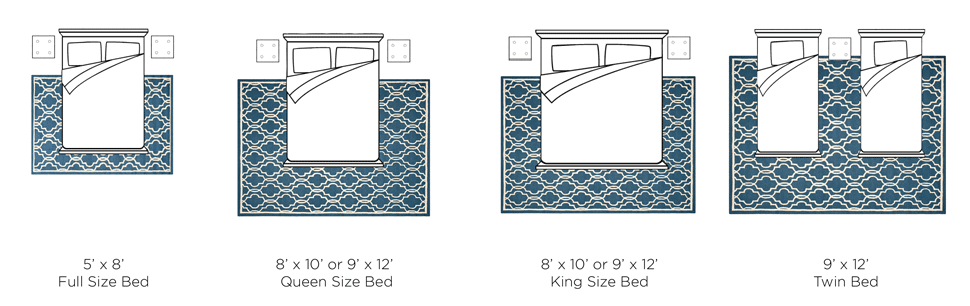
The most important factors in selecting the right size area rug for the bedroom are the dimensions of your bed as well as the room.
And, if you're looking for a new bed or mattress, check out the sleep science that goes into our Safavieh Bed In-A-Box, a comfortable pocket-coil spring mattress delivered right to your front door.
- 5′ x 8′ – Full-Size Bed – This rug works best when placed horizontally under the bottom two-thirds of a full-sized bed, the rug exposed in front and on both sides.
- 8′ x 10′ or 9′ x 12′ – Queen Size Bed – Follow the same general suggestions with larger rugs and a queen-size bed. Place the rug perpendicular under the bed with enough of the rug reaching out on the sides and in front to place your feet comfortably when getting out of bed or sitting at the foot.
- 8′ x 10′ or 9′ x 12′ – King Size Bed – Remember the "Bigger is Better" rule when it comes to arranging an area rug under a king-size bed. A rug that is too small will detract from the grand look and dimensions of the entire room.
- 9′ x 12′ – Twin Beds – In a bedroom with one twin bed, select an area rug that is large enough to be exposed 18 – 24 inches in front and on the side. For larger rooms with two twin-size beds arranged side by side, a 9′ x 12′ rug is the perfect size to connect and balance the furnishings of the entire room.
Here are a few tips to consider:
- Material plays a vital role in creating a soft, cozy, and serene environment. Consider plush materials like thick pile wool or shag that have a relaxing feeling for underfoot.
- Choosing light colors and pastels helps add calmness to the atmosphere, whereas patterns can add character without overpowering the rest of the decor. Silk rugs are also a great example that does the same.
- Dark colors, such as brown rugs, will add more drama and foundation to the room. Go for our vintage rugs if you want to add an artistic, eclectic and elegant vibe to your room, whether you have modern or traditional furniture.
- When you choose the rug, make sure there is a space on both sides of your rug when it's tucked under the bed. If it's smaller than your bed's, then it may give a too-small and squished feel.
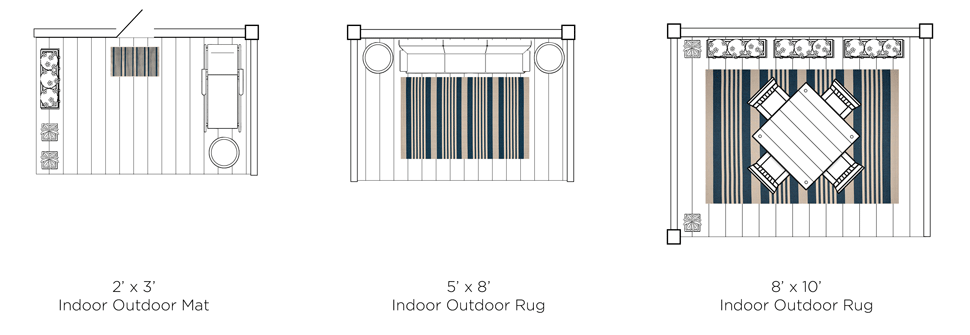
Choosing Area Rug For Screened-In Porch/Patio/Lanai
A well-chosen indoor-outdoor area rug can add warming, soft textures and a splash of color to any leisure-time living area of your home.
- The best advice for arranging a rug on a patio or screened-in porch is to consider the furnishings (table & chairs, couches, bed, or futon) and then position the rug accordingly. Consider adding oval rugs to highlight the furniture even more.
- Keep in mind the general guidelines for making sure the rug is big enough to accentuate the dimensions of the space and accommodate chairs around an outdoor dining set.
- For hallways, landings or the stairs near the front porch or inside the house, the best option is to go for our stair tread rugs which are designed to prevent slips and add comfort underfoot.
Click here to see Safavieh Outdoor Furniture for the porch, patio, or outdoor deck.
Choosing Area Rug For The Runner
Choose a runner that leaves a visible border of floor on both sides and clears doors when they open. Also, the length of the runner should not be exactly the length of the hallway.
Here are some tips to consider:
- For those who have really long hallways, choose the one long runner, even though it can be a bit on the piracy side.
- As a good alternative, you can also consider two shorter ones, but do consider where the split happens in order to avoid issues like tripping over the rugs.
- Your hallway furniture's front legs, whether it's a cabinet or bench, should sit either on or off of your runner rugs.
- To avoid the doors that open into runners and catch every time, pick the thickness so it allows a hassle-free experience.
- Having a height on your run rug can be suitable if you have a door that opens up to the runner.
- You can choose vintage, shag, contemporary, farmhouse or even antique rugs for your hallways.
Conclusion
Investing in the right rug can help in enhancing any room in your house. It can add more style and comfort and improve its overall functionality.
To get the best out of your area rugs, choose the specific needs of your room so it can stand out and look great. In general, consider all the crucial aspects so you won't end up buying too small or too large.
With these tips and information, ensure you have the perfect-looking area rug for each room!
FAQS
- What are the standard sizes for area rugs?
Area rugs are categorized into small, medium, larger, and larger. The standards include 3 x 5, 5 x 8 , 8 x 10, 9 x 12 and 12 x 15. - What is the rule of thumb for area rugs?
When buying, the area rug is to leave around 18 inches of exposure around the rug's parameter. However, for small rooms, it should be around 8 in. - Is a 5×7 area rug too small?
A 5 x7 area rug offers a medium-sized rug that can be suitable for small rooms like living rooms and bedrooms. But it can be too small if you are considering larger spaces. - Is a 9×12 rug actually 9×12?
The 9 x 12 rug offers a standard size, which is 108 in x 144 in.